
How Long Do Refurbished POS Systems Last?
A Practical Guide for Retail, Grocery, Pharmacy, QSR, Convenience and Distribution Leaders
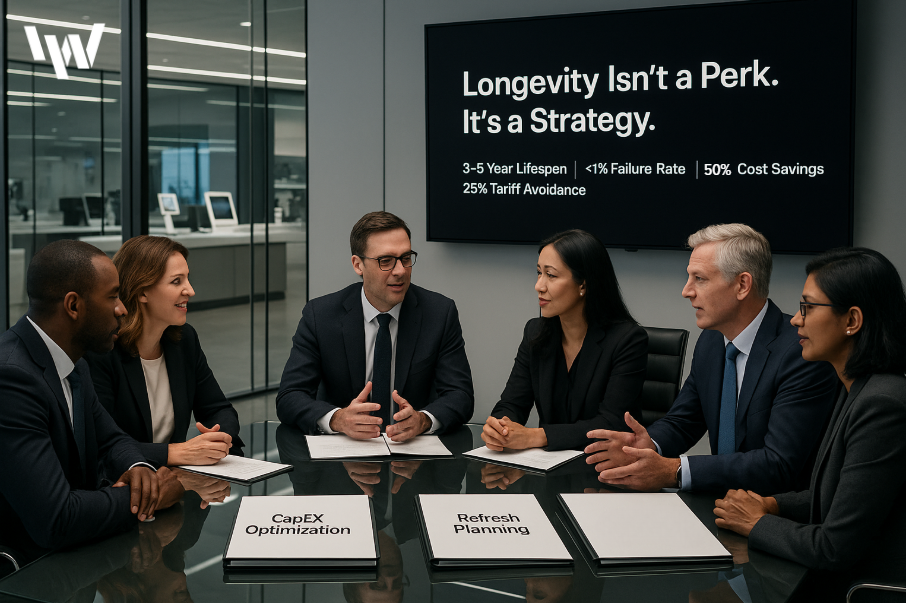
Refurbished POS systems typically last 3 to 5 years; however, they can last even longer depending on the equipment type and operating environment. In addition, longevity is driven not by the label, but by the quality of the refurbishment process.
With <1% failure rates and support for platforms sunset more than 25 years ago, enterprise-grade refurbished systems have proven they can match or exceed the performance of new hardware at a fraction of the cost.
Why Lifespan Is Now a Strategic Metric
Extending the life of hardware isn’t just a cost-saving tactic; instead, it’s a core part of infrastructure strategy. Because OEMs are accelerating product sunsets and hardware costs are rising, refresh cycles are no longer routine. As a result, leaders must plan budgets carefully. Meanwhile, downtime risk makes lifespan even more important.
So, How Long Do Refurbished POS Systems Actually Last?
When systems are restored using board-level diagnostics, component replacement, testing, and deep sanitation, refurbished hardware can deliver 3 to 5 years of consistent performance. As a result, many enterprises rely on it as a dependable long-term solution.
The most reliable refurbishment programs include:
- A 90-day standard warranty
- Optional 3–5 year extended coverage
- Ongoing maintenance and part availability even for legacy equipment no longer supported by OEMs
Why does it last? Because it’s not just cleaned and resold. It’s restored at the component level, tested, and reconditioned to meet real-world demands.
This is why some of the most complex, high-volume retail and QSR environments continue to rely on refurbished systems well beyond their initial lifecycle forecasts.
When hardware is maintained correctly, it doesn’t just last. It performs.
For more on performance guarantees, see our blog Is Refurbished POS Hardware Reliable?
Refurbished vs New POS Hardware: How Long Do Refurbished POS Systems Last in Comparison?
Here’s how refurbished hardware compares with new OEM systems in real operational environments if refurbished, supported and maintained correctly.
| Hardware Type | Average Lifespan | Warranty Coverage | Failure Rate |
|---|---|---|---|
| New POS Hardware | 4–6 years | 1–3 years (OEM standard) | Varies |
| Enterprise-Grade Refurbished Hardware | 3–5 years | 3–5 years (optional SLA) | <1% |
The reality is clear: ‘New’ doesn’t guarantee a longer lifespan or lower risk. On the other hand, when refurbishment is executed to enterprise standards, refurbished systems perform just as well. In fact, they often come with better support and lower total cost of ownership.
When refurbishment is executed to enterprise standards, performance and longevity are on par with new hardware often with better support and lower total cost of ownership.
How Refurbished POS Hardware Achieves Long-Term Performance and Reliability
Longevity isn’t a byproduct; instead, it’s a deliberate outcome of the refurbishment process. Moreover, every step is designed to extend useful life.
The process is built around extending useful life and reducing total lifecycle cost, particularly in environments where uptime, throughput, and legacy continuity are critical.
1. Component-Level Restoration
Each unit undergoes board-level diagnostics, with proactive replacement of high-risk components—capacitors, fuses, and fatigue-prone connections even if they haven’t yet failed. The goal: reduce unplanned downtime and extend field performance across years, not months.
2. Predictive Stress Testing
Each device is tested not just for current functionality, but for performance under load, temperature, and simulated wear patterns.
3. Operational Cleanliness & Durability
Internal heat and residue are common causes of premature failure especially in high-transaction environments. Every unit is deep-cleaned, inside and out, and finished with a two-part, scratch-resistant industrial coating that protects against wear in customer-facing locations.
These are not cosmetic enhancements. They are preventative measures, designed to reduce field failure and maximize lifecycle ROI.
Lifecycle Support That Aligns With Operational Realities
Longevity is about more than restoring. It’s also about what happens after deployment. The right refurbishment partner will offer service options that align with how your business operates:
Advance Exchange
Replacement hardware is shipped immediately upon confirmation of failure without waiting for the return. This reduces lane downtime in high-throughput operations like grocery, pharmacy, or QSR.
Depot Repair
For backup or non-critical equipment, depot repair offers a cost-efficient path to resolution while keeping your spares in rotation and budgets under control.
On-Site Break/Fix
For environments where on-location intervention is required, we dispatch certified field technicians ensuring resolution at the point of use, without disrupting broader IT workflows.
All service levels can be tailored to SLA requirements and integrated with extended warranties. Therefore, businesses gain flexibility to match support with operational needs. In addition, options like advance exchange or depot repair help control costs. Meanwhile, on-site break/fix ensures uptime in high-volume environments.
Legacy Infrastructure Support. Designed for Continuity
Many enterprise environments continue running hardware that OEMs sunset more than 20 years ago. A qualified refurbishment partner maintains active inventories and in-house expertise to support these platforms with:
- Full warranty coverage
- Access to replacement parts
- System continuity
In these cases, the priority isn’t just refresh. It’s about maintaining uptime, protecting service SLAs, and extending infrastructure value on your own terms.
Final Thought: Longevity Is a Lever
Refurbished hardware isn’t a compromise; instead, it’s a strategic decision about risk and continuity. Ultimately, organizations gain greater control over lifecycle investments. Because every choice matters, extending hardware longevity becomes a lever for ROI.
When you invest in enterprise-grade refurbishment, you’re choosing:
- Greater control over hardware lifecycle on your terms, not the OEM’s
- Expanded options when faced with accelerated product sunsets
- Stronger ROI from capital investments you’ve already made
At IW Technologies, we don’t just restore hardware. We restore flexibility, control, and predictability to your tech lifecycle. We’ve got one of the largest stocks of used POS hardware in the world, spread across more than 240,000 square feet of warehouse space and 18,000 pallet positions. That scale lets us move fast when customers need it.
We support over 7,500 businesses, keep 35,000+ checkout lanes running, and cover more than 9,600 locations across North America.
With <1% failure rates, 3–5 year warranties, and national-scale service infrastructure, we help organizations reduce capital strain without sacrificing uptime or reliability.
Because the real question isn’t how long refurbished hardware lasts. It’s how much value and control you can unlock when it’s done right.
Ready to See What Refurbished Could Really Deliver?
Want a quick way to size up the savings and long-term value? Let’s talk.
Explore how refurbished systems can support your next refresh, rollout, or infrastructure initiative without adding unnecessary capital strain.
In a time when budgets are tight and every choice matters, getting more longevity out of your hardware isn’t just helpful. It’s smart business.
