
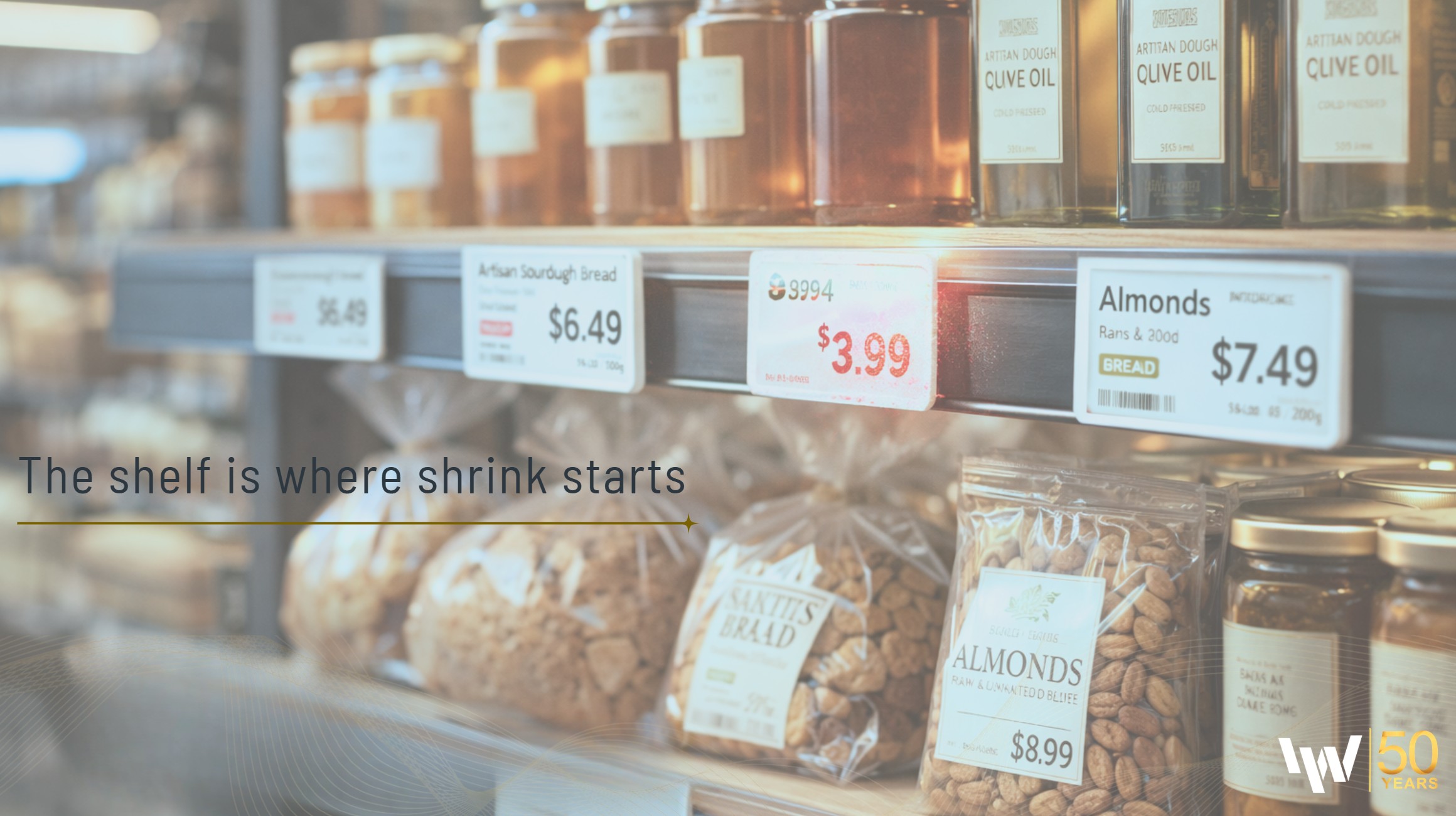
The Hidden Link Between Shelf Errors and Shrink. And How Electronic Shelf Labels Fix It
TL;DR: Small shelf mistakes from wrong prices to missed markdowns add up fast, driving millions in grocery shrink every year. Electronic Shelf Labels bring those systems into sync, updating promos and expiration dates automatically to reduce waste, recover margin, and keep pricing accurate across every aisle.
Shrink’s Hidden Cost Starts at the Shelf
Shrink costs U.S. grocers more than $100 billion each year, according to research cited by the National Retail Federation. What’s less visible is how much of that loss begins with small shelf-level errors promo tags printed late, outdated expiration labels, or a single missed markdown that leaves product unsold.
As grocers face labor shortages and tighter promo cycles, manual shelf updates have become a silent profit drain. That’s why many retailer and grocery chains are now treating ESLs not as signage but as infrastructure.
What Causes Shrink in Grocery and How Shelf Errors Contribute
Shrink covers all value lost between receiving and sale: spoilage, markdowns, mispricing, administrative mistakes, and theft. McKinsey’s Beating the Shrink study highlights that operational breakdowns not theft now account for a major share of losses.
Shelf errors often sit at the root:
- Incorrect promo or price tag – margin leakage or overcharge risk.
- Late markdowns – expired product write-offs.
- Manual relabeling misses – inconsistent pricing across channels.
- Omnichannel mismatch – returns and lost trust when app and shelf differ.
- When you’re managing tens of thousands of SKUs, even a 1%pricing or labeling error can quietly drain millions through missed sales and unsold stock over the course of a year.
The Top Mechanisms That Convert Shelf Errors Into Shrink
- Promo inaccuracies: Manual promo changes are a frequent root cause of pricing mismatches, eroding margin and triggering audit exceptions. Industry reporting and operational case studies often cite promo execution as a top error vector.
- Missed markdown windows: While exact figures vary by category, retail studies suggest that delayed markdowns in perishables can reduce sell-through by 15–25% (or more), accelerating spoilage and waste risk.
- Labor pressure: When store staff manually re-tag hundreds or even thousands of items for a BOGO or limited-time promotion, the sheer scale and time constraints heighten the risk of mistakes. Industry case studies and ESL adopter reports consistently link manual updates under tight windows to pricing errors and margin leakage.
- Omnichannel parity: In retail deployments, price mismatches between shelf and POS systems frequently become a key cause of customer refunds and order cancellations. Ensuring exact alignment through ESLs helps reduce that friction.
Impact Deep Dive
Promo Accuracy
In fast-moving grocery categories, even a brief delay in activating a BOGO promo, say two to four hours, can materially hurt margins. By ensuring “6 a.m.” promotions go live exactly at 6 a.m., ESLs help prevent lost sales and margin leakage during peak traffic windows.
Labor Dependency According to the U.S. Chamber of Commerce, stores spend up to 50 hours per week printing, sorting, and replacing paper tags. ESL automation reduces that workload by 60–90%, redirecting associates toward merchandising and guest service instead of paper management.
Omnichannel Price Parity
When shelf and POS pricing are synchronized, pricing disputes become far less frequent. Retailers report that ESL integration significantly lowers price-mismatch risk by ensuring updates on shelf and checkout happen simultaneously. (Independent Grocers Association, IGA).
How Electronic Shelf Labels Reduce Shrink
1. Real-Time Price Integrity
ESLs connect directly to the POS or ERP. Every update whether a daily price change or weekend promo appears at the shelf within minutes, closing the gap between data and display.
2. Expiration Workflows & Markdown Automation
Smart ESL platforms manage expiration timelines, trigger auto-markdowns, and support LED “pick-to-light” prompts for rotation. Waste declines because near-expiry items move faster.
3. Waste Reduction & Labor Reallocation
Instead of replacing thousands of tags, staff verify exceptions digitally. Labor saved can be re-channeled into fresh-department quality checks an area McKinsey links directly to lower shrink.
4. Compliance & Audit Readiness
Every price change leaves an audit trail. That transparency helps retailers stay consistent with state unit-pricing and price-posting laws, reduces overcharge risk, and protects against regulatory fines and consumer complaints (as outlined in NIST’s retail pricing tables and state enforcement cases).
5. Integration Foundations
Modern ESL systems rely on standard APIs, 2.4 GHz RF networks, and multi-year lithium batteries. Integration readiness – POS version, Wi-Fi coverage, API mapping is the critical first step, not an obstacle.
Building the Business Case: Pilot, KPIs & ROI
Pilot Design (8–12 weeks)
Start with two or three store formats and target categories with high spoilage: dairy, meat, and bakery. Run side-by-side tests against control stores.
Key KPIs
- Shrink rate by category (aim for 5–15% improvement)
- Promo price accuracy (> 99%)
- Expired product write-offs (before vs after)
- Labor hours per reset or promo cycle
- Customer price dispute count
ROI Model (illustrative)
Baseline grocery shrink averages 2–3% of sales. If even one-quarter of that stems from shelf errors, a 1% improvement yields millions per year per region. For pilot ESL deployments see payback within 18-24 months according to Solum.
Objections & Rebuttals
“The upfront cost seems high.”
Hardware costs have risen with tariffs and materials, but ESLs return value through precision and efficiency. By automating shelf updates and ensuring real-time accuracy across POS and ERP systems, most grocers recover the investment within two years through lower labor spend, cleaner audits, and reduced operational shrink.
“Integrating with POS sounds risky.”
Modern APIs and certified middleware make integration straightforward; start with a limited pilot.
“What about battery maintenance?”
Labels typically last 5–7 years. Plan replacements by department rotation, not individual units.
Implementation Playbook
1. Assessment: Map POS, ERP, planogram systems; baseline shrink data.
2. Pilot: Run 8–12 weeks in high-impact categories.
3. Measure: Track shrink, promo accuracy, labor hours, and price disputes.
4. Scale: Expand by region and category using a pod model for support.
5. Govern: Hold quarterly KPI reviews before next phase funding.
Executives who treat ESL rollout as a change-management project not a hardware install see faster adoption and smoother operations.
Next Steps
Shrink doesn’t vanish through better training alone. It requires systemic accuracy. ESLs deliver it.
Schedule an ESL assessment to identify shrink and shelf-error savings opportunities. Bring your latest promo calendar, category-level shrink data, and POS version details to the discussion.
Conclusion
Every mis-tagged promo or outdated label chips away at margin a little at a time. ESLs close that gap by keeping what’s in the system aligned with what customers see on the floor. When the shelf tells the same story as your data, shrink falls, waste slows, and pricing integrity becomes the norm. Not the exception.
