
Refurbished HP, NCR, Toshiba, Lenovo, Epson and Oracle POS Hardware: Are They Worth it?
Why Refurbished POS Hardware from HP, NCR, Toshiba, Lenovo, Epson, and Oracle Matter More in 2025 and Beyond
Refurbished HP POS hardware, along with systems from HP, NCR, Toshiba, Epson, Lenovo, and Oracle, is becoming a critical strategy in 2025. IT and operations leaders face a core dilemma: how to keep systems current while budgets struggle to keep pace. Gartner estimates global device spending will hit about $810 billion this year, much of it driven by refresh cycles moving faster than most companies can afford.
That data point isn’t just a number. It’s a catalyst. The IT, Infrastructure, Operations, and Finance leaders are challenging the default refresh strategy and questioning: Should we only buy NEW to move forward?
When a system goes down, the fastest way to keep lanes open is often with refurbished parts. Reliable doesn’t always mean brand new. It means hardware that works when you need it most.
HP, NCR, Toshiba, Lenovo, Epson, and Oracle: What Five Decades of Refurbishing POS Hardware Tells Us
At IW Technologies, we’ve spent decades restoring the industry’s most widely deployed POS systems and we know which models enterprises rely on most. On the HP side, we are frequently refurbishing the RP5810, Flex Pro C, and A799-C80 units that continue to anchor enterprise fleets. For NCR, that means high-performing terminals like the 7773 CX5 and 7607 XR8, as well as the 7169-7011 printer.
Toshiba platforms such as the 6149-5CD and 4900-786 remain in demand, supported by peripherals like the 6145-2TC printer. In hospitality and retail, Oracle MICROS Workstation 5A and Workstation 620 devices, along with the DT317CR tablet, are still essential to daily operations. And across checkout lanes nationwide, Epson printers from the TM-H6000V and TM-T88V to the TM-L90 and TM-U220 continue to be the backbone of transaction processing.
This kind of range doesn’t happen by chance. It comes from more than 50 years of hands-on refurbishment work, thousands of successful rollouts, and a clear focus on keeping critical systems running well past the point when OEMs stop supporting them. These models are still in use in 2025 for one simple reason: they perform. And with IW’s refurbishment process behind them, they keep delivering reliability and value at scale.
The takeaway: whether it’s HP, NCR, Toshiba, Lenovo, Epson, or Oracle, IW knows how to extend the lifecycle of the hardware that enterprises depend on most.
Refurbished vs. New: Cost Savings and ROI
Why refurbished HP, NCR, Toshiba, Lenovo, Epson, and Oracle POS Hardware Deliver Smarter Economics
For IT, procurement, and finance leaders, the economics of POS hardware procurement have shifted. New terminals now average over $1,000 per unit, driven by a combination of 25%+ import tariffs, component inflation, and accelerated OEM sunset cycles. At scale, across hundreds or thousands of lanes, this isn’t a line-item purchase it’s a seven- or eight-figure capital strategy decision.
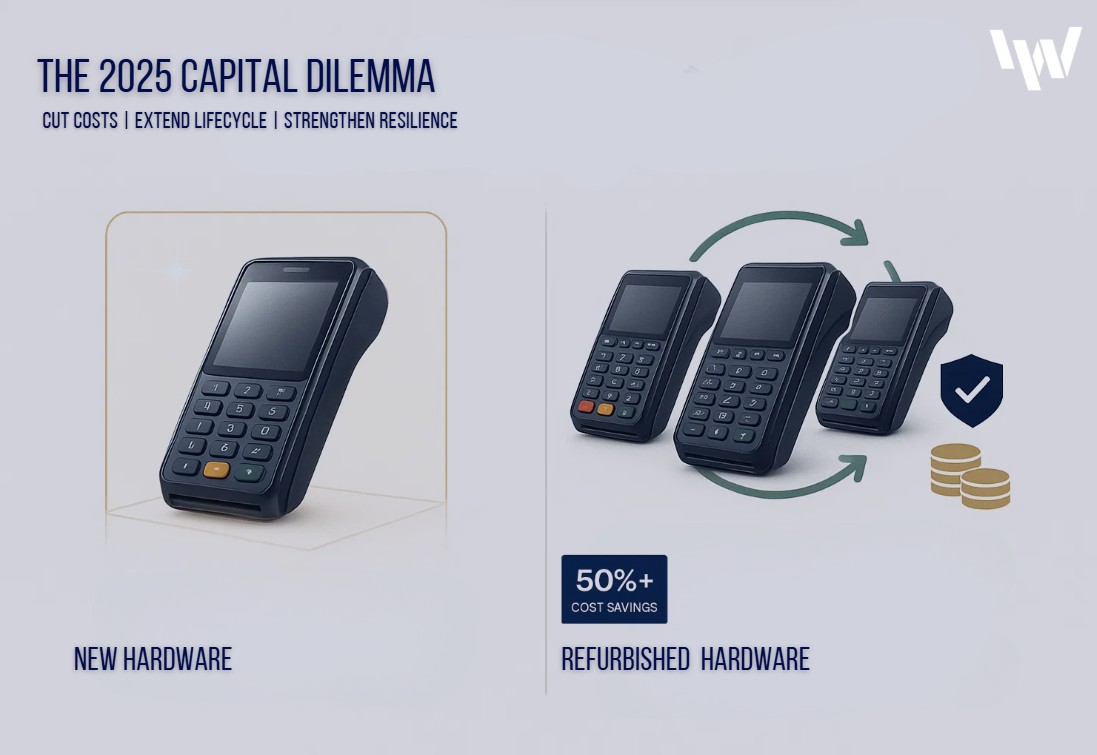
Refurbished POS systems from HP, NCR, Toshiba, Lenovo, Epson, and Oracle offer a proven alternative. Savings can exceed 50% compared to new, translating into millions of dollars in preserved CapEx for enterprise-scale rollouts. At the same time, IW Technologies delivers certified, future-ready refurbished hardware with:
- <1% failure rates, rivaling or even outperforming new in enterprise deployments
- 3–5 year extended warranties, compared to the typical 1–3 years offered by OEMs
- A 50+ year track record supporting retail, grocery, QSR, hospitality, and distribution leaders where uptime isn’t optional
In today’s environment, shaped by tariffs, OEM sunsets, and shortened hardware lifecycles, refurbished hardware is more than a cheaper option. It’s a smarter capital strategy.
At IW Technologies, this translates directly to:
- Millions saved on a 1,000-terminal rollout
- Lifecycle continuity for hardware platforms sunsetted more than 25 years ago
- Confidence that even legacy systems remain supported with modern warranties and parts availability
Even OEMs like HP, NCR, Toshiba, and Epson continue to rely on refurbished hardware to fulfill service obligations. That’s not a workaround. It’s operational validation at the highest level.
Why does this matter? Because refurbished HP, Toshiba, Lenovo, and Epson POS systems don’t just lower costs. They extend lifecycle value, preserve enterprise agility, and free budget for higher-impact initiatives, while ensuring performance where it counts most: at the point of sale.
Reliability Backed by Enterprise-Grade Refurbishment
Keeping hardware running for the long haul isn’t luck. It comes from a refurbishment process built to squeeze more years out of every unit while keeping costs down. That’s why HP, NCR, Toshiba, Lenovo, and Epson systems still show up every day in tough retail and restaurant environments places where a down lane means lost sales and legacy gear still has to pull its weight.
The IW refurbishment process includes:
Component-Level Restoration
Each unit undergoes board-level diagnostics with proactive replacement of high-risk bulging components capacitors, fuses, and fatigue-prone connections even before failure occurs. The result: reduced unplanned downtime and extended field performance across years, not months.
Predictive Testing
Devices are tested not only for current functionality, but also under load, heat, and wear patterns that replicate real-world retail and QSR conditions.
Operational Cleanliness & Durability
Every unit is deep-cleaned internally to eliminate heat and residue buildup… common causes of premature failure. A two-part, scratch-resistant industrial coating ensures durability in customer-facing environments.
These are not cosmetic upgrades; they are preventative measures designed to maximize lifecycle ROI and protect performance in the most demanding operating conditions. Many CIOs first ask whether refurbished POS hardware is truly reliable, and the data shows it is.
Lifecycle Support That Aligns With Operational Realities
Longevity is about more than restoring. It’s also about what happens after deployment. The right refurbishment partner will offer service options that align with how your business operates:
Advance Exchange
Replacement hardware is shipped immediately upon confirmation of failure without waiting for the return. This reduces lane downtime in high-throughput operations like grocery, pharmacy, or QSR.
Depot Repair
For backup or non-critical equipment, depot repair offers a cost-efficient path to resolution while keeping your spares in rotation and budgets under control.
On-Site Break/Fix
For environments where on-location intervention is required, we dispatch certified field technicians ensuring resolution at the point of use, without disrupting broader IT workflows.
All service levels can be tailored to SLA requirements and integrated with extended warranties. Therefore, businesses gain flexibility to match support with operational needs. In addition, options like advance exchange or depot repair help control costs. Meanwhile, on-site break/fix ensures uptime in high-volume environments.
Legacy Infrastructure Support. Designed for Continuity
Many enterprise environments continue running hardware that OEMs sunset more than 20 years ago. A qualified refurbishment partner maintains active inventories and in-house expertise to support these platforms with:
- Full warranty coverage
- Access to replacement parts
- System continuity
In these cases, the priority isn’t just refresh. It’s about maintaining uptime, protecting service SLAs, and extending infrastructure value on your own terms. Maintaining older systems also raises questions about software compatibility. Our insights on refurbished POS systems and modern software readiness show how enterprises extend value while staying compliant.
Sustainability: Reducing E-Waste While Preserving Capital
For enterprise leaders, sustainability is no longer a peripheral concern. It’s a boardroom priority that directly influences brand equity, compliance, and investor confidence. Refurbished POS hardware delivers measurable impact on both the balance sheet and the ESG scorecard.
In 2024, IW kept 815 tons of tech gear out of landfills cutting down on e-waste, emissions, and wasted energy across the supply chain. And every refurbished HP, Toshiba, Lenovo, Epson, NCR, or Oracle system we put back into service adds to that impact:
- Landfill avoidance through extended hardware lifecycles
- Lower carbon intensity by minimizing new manufacturing and overseas freight
- Clear ESG alignment, giving organizations tangible proof points for sustainability reporting and stakeholder communications
dual ROI: preserved capital through reduced CapEx and enhanced sustainability performance that resonates with boards, customers, and investors alike. In 2025, sustainability isn’t just about doing good. It’s about building resilience into every capital decision.
What IT Leaders Should Look for in a Refurbishment Partner
When you’re choosing a refurbishment partner, a few things should stand out
- Warranty coverage that lasts – A 90-day guarantee isn’t enough. Look for partners willing to back their work with 3–5 year warranties that actually line up with your lifecycle plans
- Real refurbishment, not resale – The difference shows up at the component level. The right partner replaces high-risk parts before they fail instead of just cleaning up old equipment and moving it along
- Flexible Service Models – From advance exchange to depot repair and on-site break/fix, support must align with SLA requirements and operational realities
- Legacy Infrastructure Expertise – The ability to support hardware that OEMs sunsetted more than 20 years ago, with active part inventories and proven continuity programs
- Scale and Responsiveness – National coverage, inventory depth, and a service network capable of meeting the demands of multi-location enterprises
With these standards in place, refurbished hardware moves beyond “cost savings” to become a strategic enabler of capital preservation, operational continuity, and enterprise resilience.
Final Thought: Why Refurbished POS Hardware Makes Strategic Sense in 2025
Reliability doesn’t have to mean brand new. Refurbished POS systems from HP, NCR, Toshiba, Lenovo, Epson, and Oracle deliver proven performance, measurable cost savings, and sustainability advantages that modern enterprises can’t afford to ignore.
At IW Technologies, we don’t just restore hardware. We restore flexibility, control, and predictability to your tech lifecycle. We’ve got one of the largest stocks of used POS hardware in the world, spread across more than 240,000 square feet of warehouse space and 18,000 pallet positions. That scale lets us move fast when customers need it.
We support over 7,500 businesses, keep 35,000+ checkout lanes running across North America.
With <1% failure rates, 3–5 year warranties, and national-scale service infrastructure, we help organizations reduce capital strain without sacrificing uptime or reliability.
50% lower cost. Refurbished HP, NCR, Toshiba, Lenovo, Epson, and Oracle POS hardware isn’t a workaround. It’s the smarter capital strategy. Let’s talk.
