
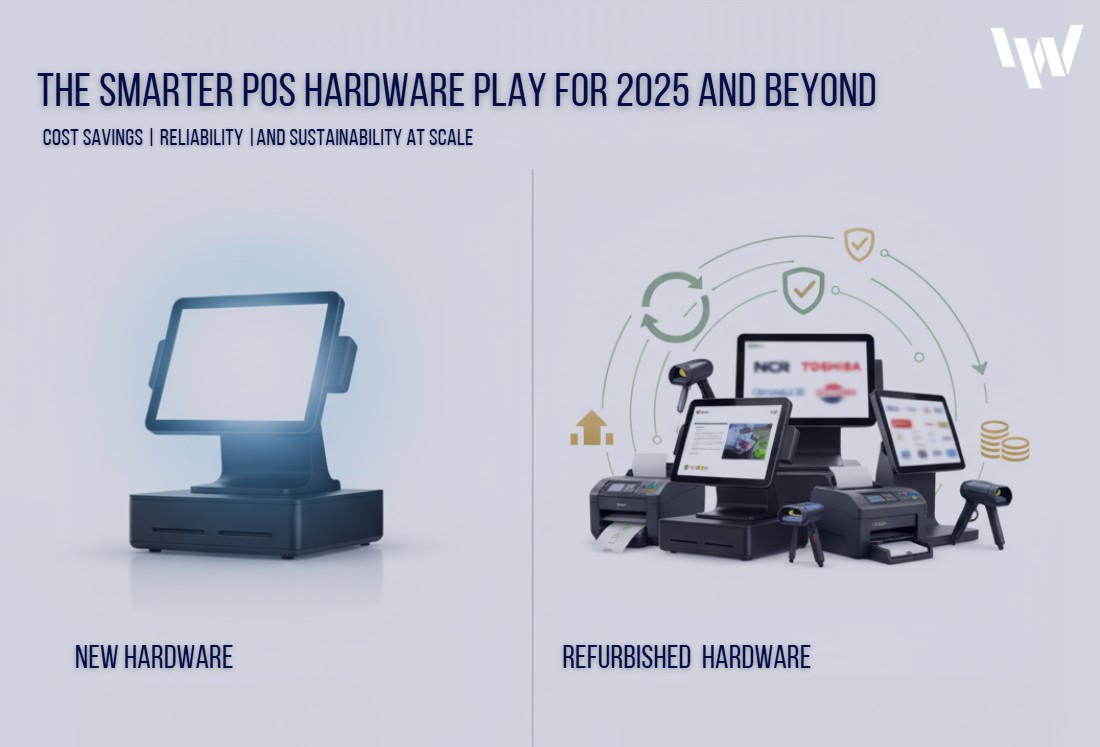
Why Refurbished NCR, Toshiba, HP, Lenovo, Epson, and Oracle Hardware Is the Smarter Capital Strategy in 2025
The Capital Dilemma Facing CIOs and CFOs in 2025
Refurbished NCR POS hardware, along with Toshiba, HP systems, Epson, Lenovo, and Oracle is becoming the go-to strategy for CIOs and CFOs in 2025. Indeed, every executive in 2025 is staring down the same tension: how to modernize mission-critical systems while at the same time avoiding overspending on refresh cycles that arrive faster than budgets can absorb. The pressure isn’t abstract. As a result, it shows up in board meetings, capital planning reviews, and quarterly forecasts.
The numbers tell the story. Gartner estimates global device spending will hit $810 billion this year, much of it tied to replacement cycles that have become shorter and more expensive. For large enterprises, that’s not just an IT expense anymore. It’s a capital allocation question that can push into seven or eight figures when multiplied across thousands of terminals.
Therefore, CIOs, CFOs, and procurement leaders are asking a simple but strategic question: Do we really need to buy new every time? Increasingly, the answer is no.
Refurbished NCR, Toshiba, HP, Lenovo, Epson, and Oracle hardware isn’t a fallback. It’s a deliberate choice a way to preserve capital, extend lifecycle value, and reduce risk, all while keeping frontline systems running at enterprise scale.
Enterprise-Grade Refurbishment: More Than Just Cost Savings
Refurbishment can mean very different things depending on who you partner with. At the low end, some vendors “wipe and resell,” moving hardware back into circulation with little more than a cosmetic refresh. Sure it would help save costs in the short term. However, it won’t deliver reliability or confidence an enterprise needs when uptime drives revenue.
In contrast, at IW, refurbishment means something else entirely. Instead of stopping at surface fixes, it’s a process to restore systems to enterprise-grade standards:
- Board-level diagnostics and proactive replacement of high-risk components before they fail
- Predictive stress testing that simulates heat, load, and wear in real-world retail environments
- Deep sanitation and industrial refinishing to extend durability in customer-facing settings
This difference is why some of the world’s most recognized retailers, grocers, and QSR brands continue to trust refurbished hardware in their highest-volume lanes. With more than 50 years of experience, a 240,000 sq. ft. warehouse, and 7,500+ customers supported, IW has proven that refurbished POS hardware is not a compromise. It’s a capital strategy that scales.
Enterprises need more than a cosmetic refresh. They need reliability at scale. That’s why many CIOs explore whether refurbished POS hardware is truly reliable.
Refurbished NCR POS hardware, Toshiba, Epson, HP and Oracle Systems: Models That Define Reliability
When we look at what enterprises are asking us to refurbish today, certain models consistently rise to the top. They’re not the only systems we support but they are the ones that remain in heavy use because they’ve proven reliable in real-world, high-volume environments.
- NCR POS hardware like the 7773 CX5 and 7607 XR8, along with the 7169-7011 printer, are still widely deployed in grocery and retail.
- HP – The RP5810, Flex Pro C, and A799-C80 continue to serve as fleet standards across multi-site enterprises.
- Toshiba – Systems such as the 6149-5CD and 4900-786, plus the 6145-2TC printer, remain in circulation thanks to their durability and uptime.
- Oracle MICROS – The Workstation 5A, Workstation 620, and DT317CR tablet are critical to hospitality and QSR operations where stability is non-negotiable.
- Epson – Receipt printers including the TM-H6000V, TM-T88V, TM-L90, and TM-U220 continue to be the backbone of point-of-sale transactions across industries.
These examples reflect where the demand is strongest right now. However, they don’t define the limits of what we do. IW’s refurbishment programs are built to cover a wide spectrum of NCR, Toshiba, HP, Lenovo, Epson, and Oracle hardware because extending the lifecycle of proven technology is often the smartest path forward.
In fact, even the OEMs themselves from NCR and Toshiba to Lenovo and Epson often have to rely on refurbished hardware to support customers still running platforms that have long been sunsetted. That reality says it all: when the business case demands reliability and continuity, refurbishment isn’t just an option. It’s the only way forward.
And this is where the capital strategy becomes clear: keeping proven hardware in play without overspending on new.
How Refurbished NCR POS Hardware, Toshiba, Epson, HP and Oracle Systems Deliver Cost Savings and Capital Strategy at Scale
For CFOs and CIOs, hardware decisions are no longer just about unit pricing. They’re about capital preservation and risk management. New POS terminals now average well over $1,000 per unit, inflated by 25%+ tariffs, component shortages, and accelerated OEM refresh cycles. Multiply that across a fleet of 1,000 or more checkout lanes, and what looks like a technology refresh quickly turns into a seven- or eight-figure board-level decision.
Refurbished NCR POS Hardware Lowers CapEx by 50%
In fact, refurbished hardware changes the equation. With savings of 50% or more per unit, enterprises can preserve millions in CapEx without sacrificing reliability. Consider the math:
|
Investment Category |
Cost per Unit |
Total Investment |
Estimated Savings |
|
New POS Terminal |
$1,200 |
$1,200,000 |
– |
|
Refurbished POS Terminal |
$720 |
$720,000 |
$480,000 |
That’s nearly half a million in immediate savings on a single rollout. Moreover, this doesn’t even factor in the hidden costs avoided by going refurbished.
Hidden Costs Avoided With Refurbished Hardware
- Tariff exposure eliminated on imported equipment.
- Supply chain delays sidestepped when OEMs can’t deliver fast enough.
- Training costs reduced by keeping teams on familiar systems.
The strategic impact is clear. Refurbished NCR POS hardware, Toshiba, HP, Lenovo, Epson, and Oracle systems doesn’t just cut costs. It helps executives reallocate capital to higher-value initiatives whether that’s digital transformation, store expansion, or new customer-facing innovation.
Refurbished NCR POS Hardware, Toshiba, Epson, HP and Oracle Systems Sustainability as a Board-Level Priority
For modern enterprises, sustainability is no longer a side initiative. It’s a boardroom priority that directly influences investor confidence, customer loyalty, and regulatory compliance. Every decision around infrastructure now carries an ESG dimension and POS hardware is no exception.
Refurbished hardware makes a clear impact on both budgets and sustainability goals. In 2024 alone, IW kept 815 tons of tech equipment out of landfills cutting e-waste, lowering emissions, and reducing energy use across the supply chain.
Likewise, every refurbished NCR, Toshiba, HP, Lenovo, Epson, or Oracle system put back into service adds to that impact:
- Landfill avoidance, achieved by extending the lifecycle of enterprise-grade systems
- Lower carbon intensity, thanks to reduced demand for new production and overseas freight
- Clear ESG alignment, with tangible proof points for sustainability reporting and stakeholder communications
The payoff works two ways: real savings in CapEx and measurable sustainability gains. As a result, enterprises strengthen both reputation and resilience.
In 2025, sustainability isn’t just about “doing the right thing.” It’s about making every capital decision more resilient. Choosing refurbished NCR POS hardware, Epson, HP, Toshiba, and Lenovo systems not only reduces costs but also helps organizations meet ESG goals by cutting e-waste and extending product life cycles.
What Executives Should Demand From a Refurbishment Partner
Longevity isn’t just about restoring a piece of hardware. Rather, it’s about what happens after deployment… how quickly failures are resolved, how effectively downtime is minimized, and how confidently an enterprise can plan its technology lifecycle. The right refurbishment partner doesn’t just sell equipment; they deliver continuity at scale.
Service flexibility isn’t a nice-to-have. It’s essential.
- Advance Exchange – When a system goes down, replacement hardware should be on its way immediately. That’s how you keep lanes open in busy environments like grocery, pharmacy, or QSR
- Depot Repair – For non-critical gear, a cost-effective repair option keeps spares in play and budgets under control
- On-Site Break/Fix – Sometimes you need boots on the ground. Certified techs show up at the store, fix the issue, and keep operations moving without dragging down IT
In addition, the right partner builds these options around your SLAs and stands behind them with multi-year warranties. That’s what gives executives confidence that refurbished systems aren’t just reliable. They’re aligned with enterprise planning and financial goals.
Legacy infrastructure support is equally critical
Many organizations continue to run hardware that OEMs sunsetted more than 20 years ago. A qualified refurbishment partner maintains active inventories and in-house expertise to support these platforms with:
- Full warranty coverage
- Access to replacement parts
- System continuity programs
In these cases, the priority isn’t refresh for refresh’s sake. It’s about maintaining uptime, protecting SLAs, and extending infrastructure value on your own terms not the OEM’s.
The reality is simple: refurbished hardware isn’t a compromise. It’s a strategic lever for risk management, capital efficiency, and lifecycle control. When done right, it gives executives more options in the face of OEM sunsets, stronger ROI from existing investments, and flexibility that brand-new hardware alone can’t provide.
At IW Technologies, we don’t just restore devices. We restore flexibility, control, and predictability to your enterprise technology strategy. With <1% failure rates, 3–5 year warranties, 240,000 sq. ft. of inventory, and national-scale service coverage, we help more than 7,500 businesses keep 35,000+ lanes running without disruption.
Because of this, the real question isn’t how long will refurbished NCR POS hardware, Toshiba, HP, Lenovo, Epson, and Oracle systems would last? Instead, it’s how much value and control can you unlock when it’s done right?
Finally, maintaining older systems doesn’t mean sacrificing software compatibility either. Our recent insights on refurbished POS systems and modern software readiness show how enterprises extend value while staying compliant.
Ready to extend the lifecycle of your NCR, Toshiba, HP, Lenovo, Epson, or Oracle POS systems?
Let’s talk about how refurbished hardware can preserve capital, strengthen resilience, and keep your operations running without compromise.
